



As many of you know, we have been committed to raising the quality and standard of training for therapists working with Gender, Sex and Relationship Diverse (GSRD) or if you prefer, LGBTIQA+ people since our inception in 1999.
Through the development of our training courses, we have assembled some of the smartest and best-trained therapists in this area in the world and we’re now working on a textbook to help other therapists improve their knowledge and skills about this fast-changing world of gender, sexuality and relationship diversity.
Over the summer, we held a two-and-a-half-day Think Tank with some of our faculty and alumni flying in from far corners of the world to help develop our thinking on GSRD Therapy.
One of the outcomes of this process was to add another core component to the six that Silva and I identified and wrote about in the Sage Handbook on Counselling and Psychotherapy. Fostering Joy has been added as a vital part of the therapist’s role.
GSRD Therapy Info Sheet
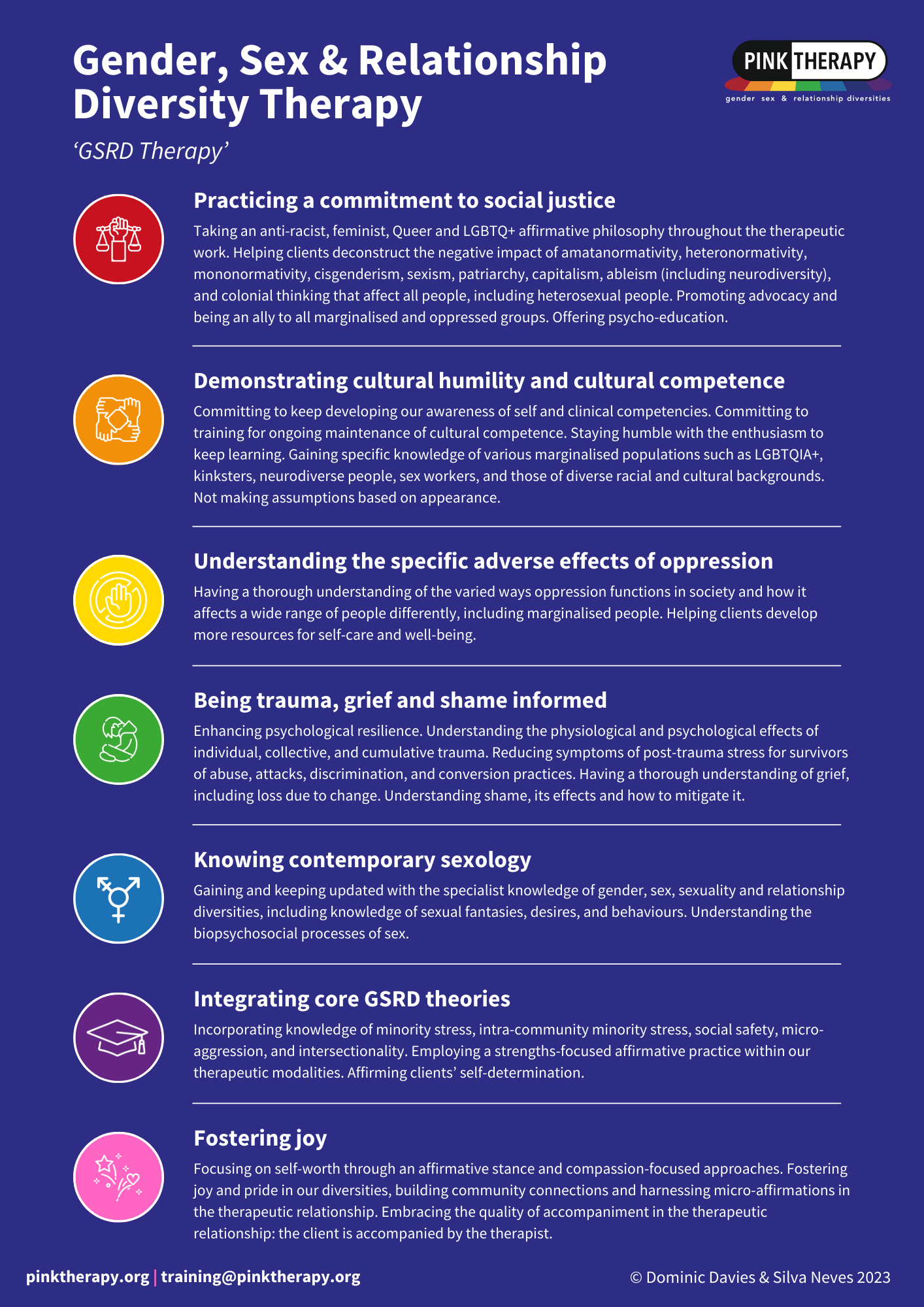
Download at full size – please credit Dominic Davies and Silva Neves.
Text version of the GSRD Therapy Info Sheet
Practicing a commitment to social justice
Taking an anti-racist, feminist, Queer and LGBTQ+ affirmative philosophy throughout the therapeutic work. Helping clients deconstruct the negative impact of amatonormativity, heteronormativity, mononormativity, cisgenderism, sexism, patriarchy, capitalism, ableism (including neurodiversity), and colonial thinking that affect all people, including heterosexual people. Promoting advocacy and being an ally to all marginalised and oppressed groups. Offering psycho-education.
Demonstrating cultural humility and cultural competence
Committing to keep developing our awareness of self and clinical competencies. Committing to training for ongoing maintenance of cultural competence. Staying humble with the enthusiasm to keep learning. Gaining specific knowledge of various marginalised populations such as LGBTQIA+, kinksters, neurodiverse people, sex workers, and those of diverse racial and cultural backgrounds. Not making assumptions based on appearance.
Understanding the specific adverse effects of oppression
Having a thorough understanding of the varied ways oppression functions in society and how it affects a wide range of people differently, including marginalised people. Helping clients develop more resources for self-care and well-being.
Being trauma, grief and shame informed
Enhancing psychological resilience. Understanding the physiological and psychological effects of individual, collective, and cumulative trauma. Reducing symptoms of post-traumatic stress for survivors of abuse, attacks, discrimination, and conversion practices. Having a thorough understanding of grief, including loss due to change. Understanding shame, its effects and how to mitigate it.
Knowing contemporary sexology
Gaining and keeping updated with the specialist knowledge of gender, sex, sexuality and relationship diversities, including knowledge of sexual fantasies, desires, and behaviours. Understanding the biopsychosocial processes of sex.
Integrating core GSRD theories
Incorporating knowledge of minority stress, intra-community minority stress, social safety, micro-aggression, and intersectionality. Employing a strengths-focused affirmative practice within our therapeutic modalities. Affirming clients’ self-determination.
Fostering joy
Focusing on self-worth through an affirmative stance and compassion-focused approaches. Fostering joy and pride in our diversities, building community connections and harnessing micro-affirmations in the therapeutic relationship. Embracing the quality of accompaniment in the therapeutic relationship: the client is accompanied by the therapist.
Source: Dominic Davies and Silva Neves, 2023.
We also created a briefer version for social media posts.
Gender, Sex and Relationship Diversity (GSRD) Therapy Social Media Image
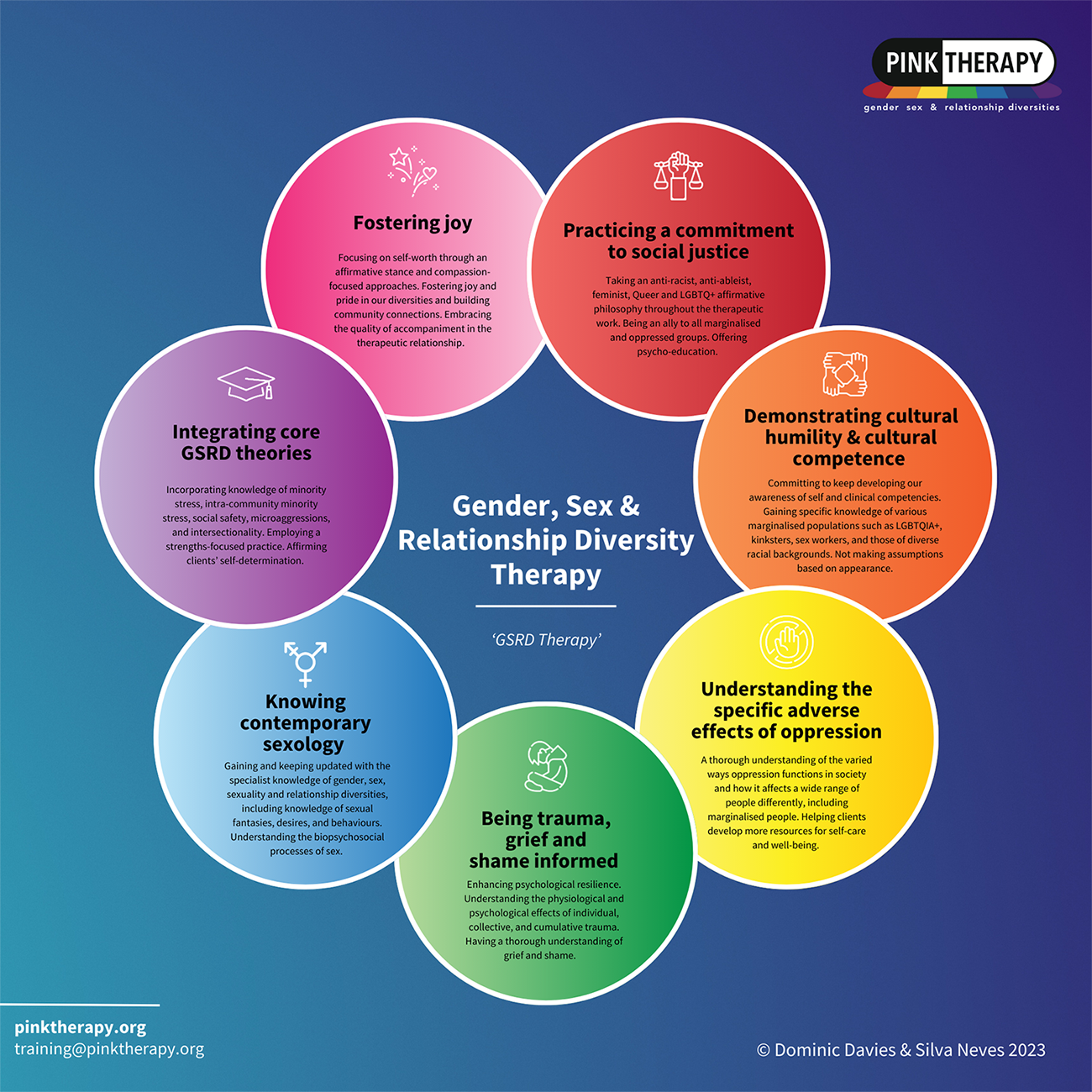
Download at full size – please credit Dominic Davies and Silva Neves.
If you are in therapy, maybe share these with your therapist and reflect on the areas covered.